

Parker Solar Probe; A Historic Journey to the Sun
The Parker Solar Probe, the fastest man-made object ever created, is set to make its closest approach to the Sun today, reaching speeds of 435,000 miles per hour. This extraordinary velocity means the spacecraft can travel from London to New York in just 29 seconds.
The probe's impressive speed is a result of the immense gravitational forces exerted by the Sun, pulling it ever closer to its core. Today, it will come within 3.8 million miles of the Sun’s surface, venturing into the Sun's corona—the super-heated outer atmosphere, which is visible from Earth during a total solar eclipse. The spacecraft will endure extreme temperatures, with its front expected to reach 1,400°C. Scientists will anxiously await confirmation that it has survived the intense conditions, with data expected to arrive on December 27.
Launched in August 2018, the Parker Solar Probe has been steadily spiraling closer to the Sun with each orbit. This is its 22nd orbit, and it marks the closest the probe will get to the Sun. Scientists are eagerly anticipating a wealth of data to improve our understanding of the Sun's behavior. Previous observations revealed unusual kinks in the Sun’s magnetic field, which generate the solar wind that drives auroras on Earth. However, this solar wind also poses a potential threat to astronauts, satellites, and power grids on Earth due to its high radiation levels.
Understanding the origins of solar wind and its effects on Earth's magnetic field is critical for improving space weather predictions. One of the key mysteries scientists aim to solve is why the Sun’s corona reaches temperatures exceeding 1 million degrees Celsius, while its surface temperature is only around 6,000°C. This anomaly remains one of the Sun's most baffling characteristics.
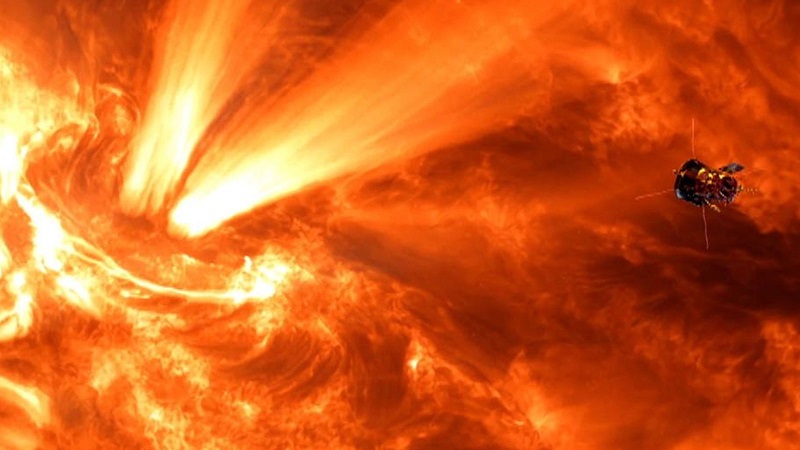 The concept of a close-up solar mission dates back to 1958, but it wasn’t until the 21st century that engineers developed a spacecraft capable of withstanding such extreme conditions. A vital part of the Parker Solar Probe’s design is its heat shield, which protects its instruments from the Sun’s intense heat.
Professor Tim Horbury, who has contributed to the research efforts, expressed his excitement about the mission’s success. He stated, “I’m incredibly lucky to be at this moment in my career when finally this mission is flying so we can do the science we’ve wanted to do for decades.” The engineering feat is just as remarkable as the scientific potential it unlocks, marking a historic milestone in humanity's exploration of the solar system.
This mission is not only a technological marvel but also promises to yield valuable insights into the Sun’s behavior and its impact on our planet. With each new orbit, we edge closer to solving some of the greatest mysteries of our solar system.
-
22:00
-
21:00
-
20:15
-
20:00
-
19:45
-
19:30
-
19:15
-
19:00
-
18:45
-
18:30
-
18:15
-
18:00
-
17:45
-
17:30
-
17:15
-
17:14
-
17:00
-
16:50
-
16:45
-
16:30
-
16:26
-
16:16
-
16:00
-
15:45
-
15:30
-
15:15
-
15:08
-
15:00
-
14:47
-
14:44
-
14:36
-
14:30
-
14:14
-
13:50
-
13:35
-
13:20
-
13:05
-
12:45
-
12:42
-
12:30
-
12:23
-
12:15
-
11:55
-
11:49
-
11:41
-
11:26
-
11:20
-
11:05
-
11:00
-
10:45
-
10:30
-
10:16
-
10:15
-
10:08
-
10:00
-
09:45
-
09:30
-
09:26
-
09:15
-
09:00
-
08:45
-
08:35
-
08:21
